Sourcing Modern Dining and Living Room Furniture from China in 2026
Walnut bentwood, velvet and sintered stone now sit at the centre of the mid-premium segment. Here is what importers, retailers and interior studios should verify before an order leaves the factory.
Most sourcing problems in modern residential furniture are not manufacturing failures. They are specification failures: a chair is built exactly to the wrong brief, packed for the wrong journey, or tested against the standards of the wrong country. Fixing the brief is far cheaper than fixing the container.
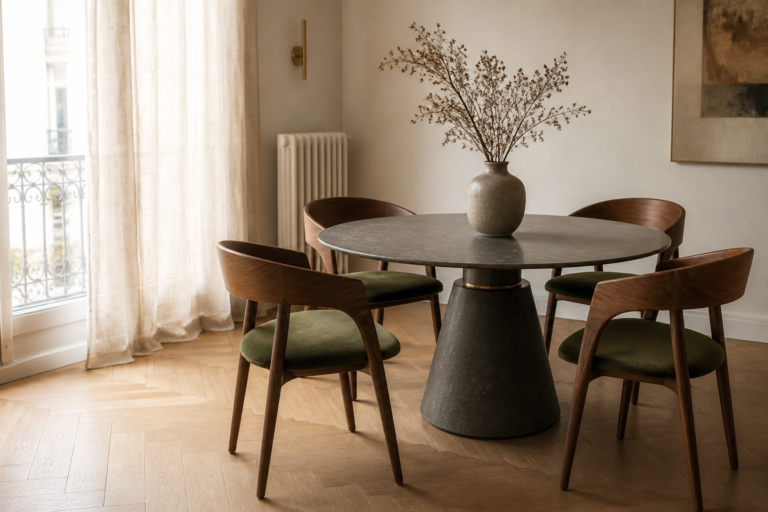
A typical mid-premium set: round sintered stone top, pedestal base, walnut bentwood chairs with velvet seats. The visual language that sells in Milan, Lyon and Toronto is now almost identical — the specification behind it is not.
1. What this category actually contains
“Modern furniture” is a marketing label, not a product category. When a buyer sends an inquiry for a dining range, what is really being quoted is a bundle of separate production lines with separate cost drivers:
Dining chairs — solid-wood frames, bent laminated backrests, upholstered seats, metal or rattan variants. The chair is almost always the hardest item in the order.
Dining and tea tables — sintered stone or slate-look tops, tempered glass, MDF with veneer, on pedestal, cross or trestle bases.
Coffee tables — round and extendable formats, marble-look and glass tops, storage versions.
A single-category supplier usually wins on chair quality; a full-room supplier wins on coordination and container efficiency. If you are building a room set, decide early which one you are buying, because the answer changes who owns colour matching between the chair frame and the table base.
2. Three materials that decide your margin
Walnut and bentwood: the joint is the product
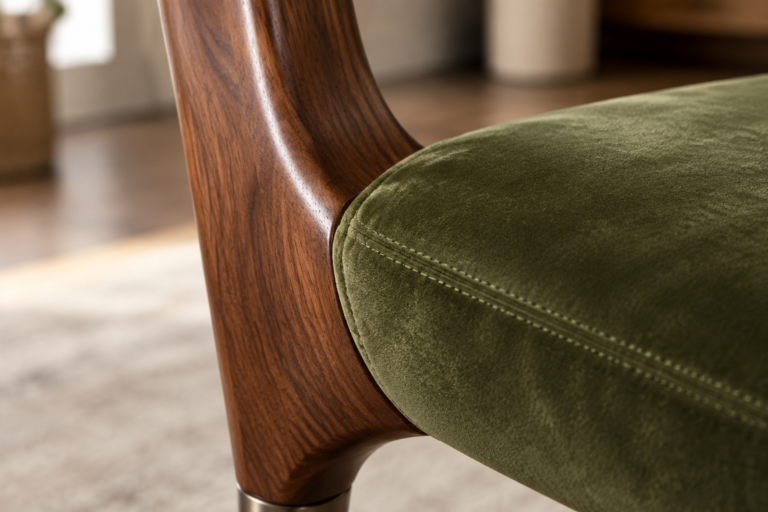
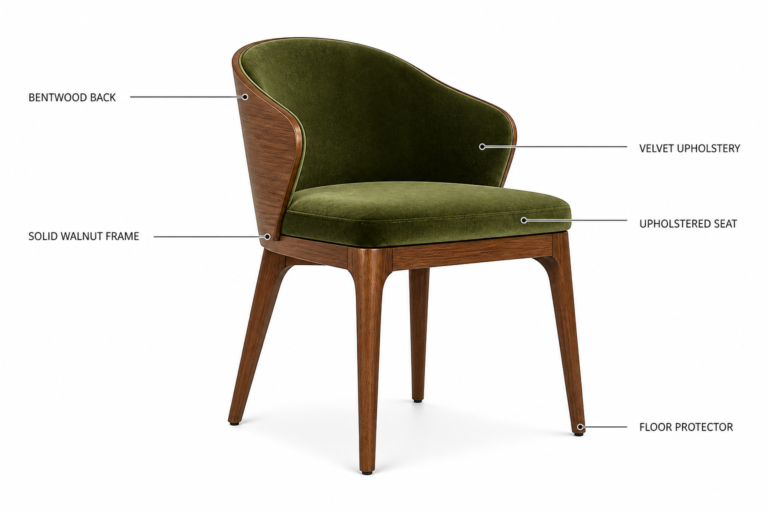
Walnut is a finish story and a structural story at the same time. Ask three questions. First, is the curved backrest genuinely bent laminated plywood or a solid timber section machined to a curve — they behave differently under load and humidity. Second, what is the moisture content at assembly, and is it measured on incoming timber or only on the finished part. Third, how is the joint between backrest and seat frame executed: dowel, mortise-and-tenon, or screws with brackets. A chair that creaks after two months in a heated apartment almost always failed at the third question.
Five externally visible features worth writing into your purchase order — not internal construction.
Velvet and bouclé: pile, rub count and cleaning code
Two fabrics that photograph beautifully and behave very differently. Velvet is judged on pile direction, crush recovery and colour fastness to rubbing and light. Bouclé is judged on loop stability — a loose loop pulls, and a pulled loop in a retail showroom becomes a markdown. For both, request the fabric’s abrasion result, the cleaning code, and a colour-fastness report against light and rubbing. Then ask the question that actually predicts complaints: is the same dye lot guaranteed across the repeat order, and what happens if it is not.
Sintered stone and slate-look tops: thickness, edge, substrate
Sintered stone solves the staining problem that made marble impractical for family dining, but it introduces edge fragility. Confirm the nominal thickness, whether the edge is mitred or eased, and what sits underneath — a full substrate, a partial frame, or nothing. On extendable models, the mechanism is the weak point: ask for the runner type, the rated extension length, and whether the leaf stores inside the table or separately. A top that arrives intact but chips at the corner in the showroom is usually an edge-profile and packaging decision, not a material defect.
Five externally visible features worth writing into your purchase order — not internal construction.
Frequently asked questions
What is the minimum order quantity for custom dining chairs?
MOQ is set per model, finish and fabric, not per store. Ask for the MOQ break at every price tier — the gap between two tiers often decides whether a mixed-container order is worth placing at all.
Can I mix several SKUs in one container?
Yes; mixed loading is normal. The real constraints are carton volume and stacking, not the number of models. Send your target carton dimensions and ask for a loading plan before you confirm quantities.
Which test reports should I request before shipping?
For the EU: EN 12520 and EN 12521, plus REACH. For the US: BIFMA X5.1 and CARB P2 or TSCA Title VI. For Saudi Arabia: SASO. Timber origin documents support EU Timber Regulation due diligence.
Do you support OEM and ODM orders?
Yes — OEM and ODM are the standard model here: custom dimensions, frame colour, fabric selection, logo labels and retail-ready packaging. Share a reference image and a target price, and feasibility can be confirmed component by component.